To the Muggles on the Other side of My Windscreen

    This might turn out to be a pedestrian writeup but enough of pile-ups. Enough of puns, actually. They say you really appreciate an interview process only if you have sat on both sides. Same goes for driving. Unless you become a driver you’ll never know what these fancy coloured tin boxes zipping past you are really thinking.
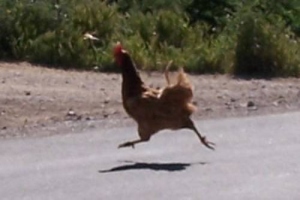
    Chicken Runs Courtesy carondelet.net

    These little nuggets of wisdom are the ones I always wanted to share to my clueless pedestrians. Sometimes, I have wanted to pull down the glass and scream till its drilled down into their thick skulls. But generally speaking, ignorance is bliss. They look so happy without this knowledge. That’s definitely not normal.

    So without further ado here are the top things that every person who comes within 100 meters close to a road must know:

    1. Hang-up - I know you love the ones you…ummmm love. But if you are walking close to the road, please do, in the name of Graham Bell, turn off the damn mobile. Unless you want your beloved to hear a live audio of a road accident, it is best to keep a close watch on the road first. I know, I know, you can multitask. But trust me, from a driver’s seat, I have honked at so many mobile-zombies till my hands ache.

    2. Don’t be shy to look at the right direction while crossing - Since you are in India, you know that vehicles come from your right. Yet, so many of us choose to carefully watch your left before leaping to the middle of the road. There might be an oil tanker blaring its horns from your right, an auto squawking endlessly in an annoying tirade and even a friendly pan-walla kaka mouthing obscenities, yet you would be transfixed to your left. I mean, what form of dark physical humour is that? Unless, you have recently completed a very long onsite trip from US or the Middle East, you ought to know that the things with wheels come from your right. No, not that right. The other right.

    3. Don’t cross in an underlit road - It is a long day and you are walking back home with that blessed device on your ear. Streetlights are alternately working and in some places pitch dark. Guess what, in your infinite wisdom, you pick the dark spot to cross the road. The next thing you know, a speeding Honda City missed you completely. Yes, they come with headlights these days. But being seen on the road and not seen, is the difference between life and death.

    4. Don’t dance in front of cars - I know that you know some moves, but tarred roads are not the best dance floors. I am referring to those half-minded pedestrians who cross the road, see an approaching vehicle, pause, then moonwalk, then pause, then move forward, then do an about-turn. Imagine the horror of the guy in that incoming vehicle. He is in a hurry and all he can see is chicken dance. So the advice is - JUST CROSS SLOWLY, the drivers will take care of manoeuvring the vehicles. Don’t be a moving target.

    5. Don’t hold hands - Don’t get me wrong, I have nothing against PDAs (not the electronic kind, the kind that couples do). There is a split second difference between a person in the line of an incoming vehicle and outside it. So don’t drag someone along while you cross. Unless the person is a clueless toddler, let that person decide whether to cross or not.

    6. Don’t pretend to be a traffic cop - There are so many not-so-old fellows who have been given the honorary tile of traffic cops… IN THEIR DREAMS. They tend to authoritatively stretch their palms to signal a stop for an incoming vehicle. They also get to decide if they have goofed up and cannot cross, to signal that we should continue driving along. Thanks, but no thanks. You are of no help, but I appreciate the straight face in times of absurdity.

    These are the ones I could think of straight off my head. But I am sure there are more. The clueless pedestrian will never cease to amuse me.
    Comments →

    Mesmerising Raavan :: Enjoy the Subtext

    Warning: May contain spoilers!

    ‘Raavan’ is not the Mani Ratnam movies of the eighties/nineties where human relationships are painted on the broader context of a social problem (Terrorism in Roja, Underworld in Nayakan). It firmly belongs to the ever-shrinking world of the 21st century and the complexity of interpersonal relationships come to the fore. However, it isn’t a run-of-the-mill revenge drama by the genius either.

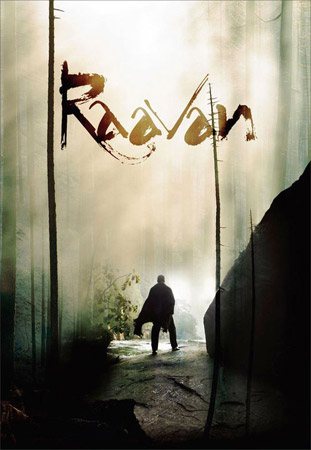
    Raavan Still - Courtesy bollyspice.com

    It has to be rather seen as a modern interpretation of the timeless epic of Ramayana. On the screen the characters unfold and the motives that drive them help you relate to their counterparts in the classic, leaving a uniquely rewarding experience. Mani has admirably adhered to the characters and have not compromised any of their attributes for the sake of novelty. Yet he brilliantly manages to give a fresh perspective in the climax.

    Unlike his earlier films, visuals do not just serve as a aesthetic backdrop. In Raavan, it is visuals that tell the story and essentially the defining character of the movie. The unique camera angles from the sideways shots of a dragon fly to the wings of an eagle in flight conveys a jungle filled with eyes. Yet, Beera the forest brigand is an elusive being momentarily seen and the next moment unseen. A maligned force hiding gloriously in plain sight. An enigmatic presence in the teeming abundance of nature. You realise at once that you are truly in Raavan’s “Golden Lanka”.

    Camera falls in love with Ragini, played by Aishwarya Rai, from the moment we find her in a raft. It slowly dives into her emerald green eyes and thus hopelessly smitten. It lazily flirts with her, falls into her tresses and even while it momentarily glances afar, only to longingly pan back to her.

    Stuck almost claustrophically in a teeming forest, Ravan heightens your senses to a state of alertness. This sensation is almost killed off thanks to the slow progression of events in the first half. But the visual feast continues till the very end and leaves a lasting impression thanks to the mavericks behind the camera.

    You can bet on ARR to effortlessly weave the music and background score into the story. The dominant tribal and folksy elements in the score amplifies the experience. Gulzar’s pen again works its magic and sometimes the story relies too much on that magic. For instance, the motives of the bandits are not fully clear and only revealed through the song ‘Thok De Khilli’. This is rather unfortunate because of the odd placement of the song in the heat of the events.

    Thankfully, the story picks up in the second half leading to some unexpected twists. Certain scenes are truly hair-raising (such as Beera confronting Sanjeevani) and Mani rewards you for your patience.

    I feel Mani has essentially conveyed the essence of Ramayana which is a study of two legendary heroes Ram and Raavan. In fact, Ram and Raavan are essentially the same heroic personality in two different moral planes by mere turn of events. The motives of Raavan were questionable, yet his conduct was indeed noble. In a different context, the roles may have been reversed and yet one might praise the virtuous characters of one versus the other. It is precisely this irony of the epic that the master story-teller Mani Ratnam has tried to portray.

    Addendum: Raavanan Review

    One of the major flaws of Raavan (Hindi) was the casting. Abhishek Bachan’s overacting and Vikram’s unconvincing portrayal as the ‘good guy’ left audience confused as these characters had shades of grey.

    On the other hand, the casting in Raavanan (Tamil) is perfect to a tee. Vikram’s subtle yet engaging performance, keeps you guessing if this brute is even capable of love. The fire and insanity glowing through his eyes justifying the eccentricities of the character. Prithiviraj perfectly suits the role of the duty bound police officer. Karthik also fits in his whimsical yet likeable character perfectly.

    The dialogues are also better in the Tamil version. Cheesy dialogues like ‘Is Beera a Robin hood or a Raavan?’ have been thankfully omitted. Some scenes by Vikram manage to convey the visual narrative better. For e.g. when Veera enters Dev’s tent (which he refers to as his palace), his shock-then-anger reaction to his mirror image is quite interesting. It effectively conveys that the Veera/Dev characters are mirror images of each other.

    In a nutshell, Raavan was boring till the end of the first half while Raavanan manage to engage till the very end. It is amazing to find such contrast in the movie experience despite identical screenplay and visualisations. So my recommendation is clear - it’s Raavanan all the way.

    Comments →

    Charge to Munnar

    We lead life like Batteries. We give out our best everyday. We push our limits harder and harder. We absorb. We respond. We re-absorb. We win. We perish. We dance in the motions of a rhythm we call Life. Yet somewhere that very thing is forgotten - Life.

    We lead such pumped up lives that eventually we are maxed out. We badly need a recharge. We badly need that long overdue vacation. I had mine last weekend. It was an getaway to Munnar in Kerala. Though it was not my first trip, it was more special with my family. Climbing those long winding roads along the misty slopes covered with tea plantations, you find a place where you can finally recharge. And thank god for that! :)

    Munnar, if you haven’t been there before, is a very different experience from, say Ooty. It has not yet been a victim of heavy tourist commercialisation where every pore of its surface has been clogged with teeming mercenaries. It still retains some of its pristine virginal green meadows and tall imposing eucalyptus trees. Even in this off-season, its lush green freshness practically invites you to spend many idyllic evenings sipping hot garden fresh tea.

    Kavya was literally on her toes all the time. With her newly gained ability to balance on her own, she has successfully crossed from a limited 2D experience to a full fledged 3D experience, as its fashionable to say these days. Her shriek expressing sheer happiness sometimes crosses into the ultrasonic barrier and is quite effective in confusing bats. Her greatest weapon is of course her oh-I’m-so-sorry smile, to which even the most stone cold hearts turn into putty in mere seconds.

    We all returned with memorable moments and saturated cameras (which seem to have more memory than us these days).

    Comments →

    At the Fireplace: Blogs in Perspective

    Hi folks, this is your friendly Granpa… It’s a chilly night out there and we’ve a nice warm fireplace inside. So grab your cup of hot chocolate, wrap yourself in a warm blanket and sit next to my armchair.

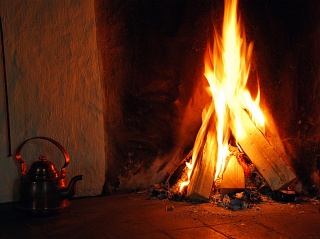
    Fireplace - Copyright flickr.com/photos/arild_storaas/

    Back in my good ‘ol days there were lots of people who called themselves Writers. When I say Writers, you might think of bespectacled young chaps hunched over a word-processor, punching out words on their Macbook draped in hand-knitted scarfs and wearing comfy flip-flops. But no, I am talking about good ol’ pen and paper blokes who toiled all day beside a mountain of crumbled paper overflowing from their wastebins. When life was hard and every word was measured and well thought out. Their prose was water-tight and flowed from line to line like a swift arrow of unbroken thought.

    There were two kinds of writers, though - Fiction and Non-fiction. The former were always popular. People loved to get trapped in their colorful web of imagination. They would get lost in far-away worlds of fire-breathing dragons or colourful unicorns. But the non-fiction writers had it tough. Every word of their’s was picked on and taken apart. “What is your reference for this?”, the critics would clamour. “Prove your claims”, the technical ones would demand.

    Despite all this, the technical writers, the journalists or the biographers wrote volumes and produced great works. In fact, the critical audience made them write impeccable and widely researched bodies of work.

    Time rolled by and the Internet happened. Now, don’t get me wrong, Internet wasn’t a bad thing at all. But, soon everyone realised that they could be and later, would be - a Writer. Nobody bothered to label themselves as Fiction or non-Fiction. Both genres would be intermixed in the same, so-called, blog-post in the interest of a greater subscriber base. After all who wants a recital of dry facts. Sprinkle some controversy and hyperboles, mix them well and let’s make merry - was the mantra.

    Soon, technical writing was not worth the… err… bandwidth (?) they used up. Hearsay became random tit-bits which became fun-facts and later authoritative references. Nobody, checked the authenticity of what was written or passed around. Eventually, nobody regarded the technical writers as well as they did. Some poor ol' timers like me found it difficult to survive by technical writing alone. So, we switched to better jobs.

    “So what did you switch too, Granpa?”, asked the little attentive one with a glint in her eyes.

    The Grandpa gave a long sigh and answered with a sour look, “Well, I write jokes for Reader’s Digest”

    Comments →

    Our Obsession with the Culture of Doing

    You cannot learn to swim by reading a book…
    You cannot learn to drive by reading a book…
    You cannot learn to code by reading a book…

    You can only learn these things by practice.

    Boy reading in the grass - Copyright flickr.com/photos/norby/

    But are reading books a waste of time? Absolutely not. Learning by doing will only get you so far as in perfecting something you already know. For instance, if you know the basics of operating a car, in due time, you can move around comfortably. This does not mean that you can take very good care of the car or understand traffic rules. Most of us learn these things through friends or a driving instructor.

    But books offer a much more reliable and insightful information (say a simple automobile service kit). They are usually written by experts in their respective fields. They have years of wisdom to back what they have written. Interestingly, this is not just applicable to non-fiction but also in fiction. Be it reading about the mathematical ingenuity of a symbologist or the experiences of hitch-hiking in a romantic Scottish highlands, the written word enriches your experiences with many lifetimes that you haven’t lived yourself.

    Similarly, programmers jump to ‘on the job trainings’ and claim to have acquired expertise based on the years of experience they’ve spent on a technology. It is quite debatable on what they have mastered. They might be able to get something working but it will be a far cry from an elegant or a well-designed solution. Reading does wonders in acquainting one with the best practices of a technology area. Indeed, the well-read ones are quite easy to spot too.

    The culture of doing is as important as the culture of learning. Both go hand-in-hand. But the emphasis must not shift purely to doing as it shows tangible results. The results must in itself demonstrate the depth of learning. Often, opening the bonnet solves the problem rather than kicking the tires.

    Comments →

    « Newer Page 14 of 39 Older »