Sony Bravia CX 420 and a Guide to Flat-panel TVs

    It is Diwali time and the retail shopping excitement in India is comparable to Christmas season in the West. Everyone seems to be praying for their old and fat CRT TV to stop working, so that they have an excuse to buy a brand new flat screen TV.

    We were on the lookout for a flat screen LCD TV sometime back and deliberated various brands for a while. Actually, for me every gadget purchase takes ‘a while’ due to the amount of research I generally do. Since, I do not watch TV regularly, I had to practically learn all the TV jargon from scratch to understand the sales-speak.
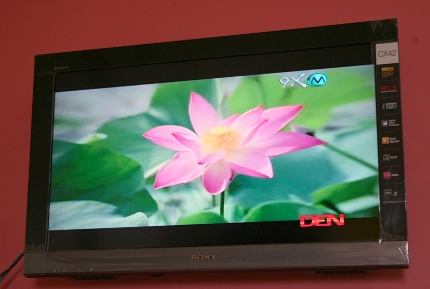
    Sony Bravia CX 420

    After a month of ‘superficial research’, some of the elementary findings were:

    • The old CRT TV is completely out of the market. You might be able to find, at best, a 21" CRT TV.

    • There are no plasma TVs in the 32" category. They only come in bigger sizes and guzzle a lot of power.

    • The market leader in Indian TV market is Samsung followed by LG. The Koreans also dominate the world market this way with low cost yet high quality TV sets.

    • LED screens today are a gimmick. It’s just LED backlighting and true LED TVs are a few years away from an average consumer’s reach. Their saturated colors in the showroom is just clever tweaking.

    • 32" is a reasonably large screen for our apartment living room. Any bigger and you will feel you are literally inside the screen. (This is subjective, of course)

    • The higher end TVs have higher frame rates for sports action. This is called by different manufacturers by different names such as Tru Motion or Flo motion. This is very annoying while watching movies as it makes them look like TV serials. This might not be perceptible to many, but personally I couldn’t watch my favourite movies being ‘interpolated’ this way

    • HD Ready (720p) would be cheaper than Full HD (1080p), but they will be obsolete soon. Interestingly for screens smaller than 36", the difference in picture quality is not quite evident but to the trained eye.

    • In most modern TVs, there is no need for a DVD or bluray player if you prefer to keep movies in your pen drive or hard disk. You can simply plug in the device directly to your TV set. The TV presents a file browser and you can play the video if the file format is supported.

    • No comments on 3D TV as it was not a requirement for us.

    All these facts were gathered after multiple visits to various showrooms and from the Internet. Initially I had visited a couple of stores in April this year and found out that, among the leading brands, only LG offered IPS displays at that point in time. Now, I know a thing or two about IPS displays because it is the same display technology used on Apple Cinema displays and even the iPhones.

    IPS displays have the widest viewing angles and excellent color reproduction. In fact, I was so impressed by IPS displays that I bought a 23" DELL IPS monitor specifically for desktop use. Hence, I was almost certain to buy an LG.

    Around May, LG and most leading brands did a refresh of their lineup of TV screens (i.e. 2011 models). LG no longer offered IPS displays for their 32 inch screens. This was extremely disappointing as this meant that I have to visit the stores again to view and reevaluate the sets.

    Visits to the nearest Samsung and LG showrooms resulted in quite a bit of disappointment. Their 32" LCD models were a shadow of their predecessors. The color reproduction was weak or dull. The sound appeared to come out of a closed box. The sales representatives were not very clear in explaining these “improvements” such as why LG decided to abandon the IPS display. I was even tempted to buy an older CRT instead!

    We then visited the Girias outlet near our apartment, from where we have made most of our purchases. The sales representative was quite patient and knowledgeable. He explained that the non-IPS displays like Twisted nematic (TN) have been improving in the past couple of years and the color reproduction was almost at par. We were able to visually compare the viewing angles and experience this for ourselves.

    When I explained to him that I found the LG and Samsung audio and video quality as being not satisfactory, he demoed a Sony Bravia model - CX 420. Now, personally, I detest the Sony brand due to their tendency to create their own standards like the Memory stick, Betamax and UMD. Also, they charge premium rates for the same feature set simply due their brand name (in laptops, for instance). Besides the number 420 does ring a bell in India :)

    But I was genuinely surprised when the model actually had significantly better picture quality, color reproduction and excellent sound (with bass) for a price premium of 3K compared to other brands. However, the most impressive feature was the wide variety of video and audio formats that was supported out of the box. Even today there are TVs that can support pen drives but not harddisks; or ones that can play .avi but cannot open .mkv videos. But the 420 could play virtually any type of file lying in my harddisk except for videos with 5.1 channel audio tracks (because, duh, it had only 2 speakers).

    So we finally settled on a Sony. Once home, we wall-mounted the unit and now its almost like a colourful window in the living room :).

    Sony Bravia CX 420 - a Post-purchase review

    What follows is a review of the TV written after 5 months of use. It goes into greater detail regarding some of the aspects covered earlier.

    Unpacking / Appearance

    Unlike the good old dabba TVs, today’s TV boxes can be carried by one person. The box contains a stand if you are mounting on a flat surface. The assembly takes about 10 mins and the printed instructions are quite clear. Wall mounting would need additional screws so it’s best that you ask the Sony personnel to wall-mount at no additional cost.

    The TV is a classy all-black model with a slightly glossy bevel. However the screen is, thankfully, matte. So a mirror-like reflection will not be present from various light sources in your living room. The steroe speakers are located at the bottom. The remote is quite long and slender. It is quite easy to hold and the button are well spaced out.

    Picture Quality

    The Bravia series models use Live Color technology which makes pictures more vivid without making them unnaturally over saturated. This combined with various noise reduction techniques makes watching non-HD content such as Cable TV channels quite enjoyable. The picture is also intelligently resized to stetch the entire HD screen without letterboxing.

    The color reproduction of HD videos is similarly quite superior to comparable brands (we did spend a lot of time in the showroom comparing this aspect alone :) ). However, Sony leaves very little room for tweaking by giving you only 4-5 preset modes like Theatre, Sports etc. Other brands might give you more parameters to fiddle with.

    The viewing angle was quite good considering that it is not an IPS display. However, the difference in vertical viewing angles seemed to vary quite a bit. Hence, it might be a factor to consider while determining the height to wall mount the set.

    There is a noticeable blur while taking photographs of the videos being played back. Hence it may or may not be the best choice for watching sports. I don’t watch much sports anyways.

    Sound Quality

    As mentioned earlier, I was not interested in connecting an external sound system like a home theatre system to the set. Hence, I was keen on a model that had good built-in sound. Compared to LG or Samsung, Sony sets seemed to have good sound reproduction even at high volumes without distortion.

    The bass enhancing technology was not very effective but it did give sufficient bass to enjoy action movies. The stereo separation is not that great considering that both speakers fire downward, but it is definitely there!

    Summary

    Overall, we are quite happy with the purchase, though we realise that our needs were quite limited to start off with. Interestingly, we found ourselves spending more time watching movies from the hard-disks (yes plural, I have quite a collection :) ) rather than watching boring television programmes. I am yet to connect my Android phone which has a mini-HDMI output to the TV yet, but I hear that it’s an excellent idea.

    Couldn’t be happier!
    Comments →

    Rockstar Soundtrack - First Impressions

    Warning: May contain traces of satire and humour

    This is, unfortunately, an unpaid review. Hence, most of what’s written here is not made up. This can be very disappointing to some of you who read mainstream media, so please take it slowly. Media is after all a business and a source of bread and butter for many people. And bread and butter is definitely expensive, especially in India.

    Don’t get me wrong, I am not the unbiased vigilante blogger. In fact, I tried my best to get paid for this music review. Apparently, Rockstar’s PR was not in a mood to humor a small-time blogger like me. Completely unfair, since being fond of Rehman’s music I would have written a pretty nice review anyways!

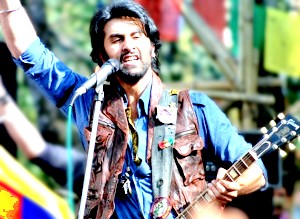
    Rockstar

    So, this review wouldn’t be too nice. Because it is written for free. So Mr. Cheapstakes, you can wipe that mocking smirk off your face. Let’s have a look at Rockstar’s playlist:

    Jo Bhi Mein - Mohit Chauhan

    Oh yeah, yeah, yeah… I can this one sing too. Have to appreciate the sense of humour of the lyricist Irshad Kamil (even better than me in this regard). The album starts with the ‘Rockstar’ yelling ‘Oh yeah, yeah’ and the audience, accepting the challenge, yells it back. This goes back and forth till you can guess who wins in the end (Hint: it’s the guy with the mic).

    The song is heavily set on guitar strings and the mimicry abilities of the singer (cost-cutting measures?), while it introduces you to the apparently always-misunderstood-protagonist. You cannot imagine someone better than Mohit rendering this rock-pop composition. The song immerses yourself into a rock concert minus the sweaty t-shirts.

    Kateya Karun - Harshdeep Kaur & Sapna Awasthi

    Can music tickle your ears till you smile? Yes it can. Listen to this one. Not sure what vodoo music engineering that Rehman employs but the opening of this track is a quirky yet hilarious stereo experience. It is great for testing your new 200 buck earphones and be unjustifiably happy about it too. How do I know that you have cheap earphones? You are reading a free review, aren’t you?

    Countless Punjabi Bollywood numbers have been created filled with ‘Ahuns’, ‘Oyes’ and ‘Brrrrraaahs’. So what makes this one different? Glad that you are wondering the same thing as I did. Funny, how that works. I guess it has to do with the innocent naughtiness in the lyrics and an equally fun rendering by Harshdeep.

    This song made me wonder why I like Rehman’s music. I realised that it’s because I understand what he is trying to convey through his music. To my musically untrained ears, when he foreshadows the ending of the track with deescalating string chords I anticipate that we are slipping into a dream. Ending on that dreamy note, I believe that the entire song is a roller-coaster ride suited for a coming-of-age situation.

    Phir Se Ud Chala - Mohit Chauhan

    There he goes up again… well, that’s what the song’s title literally means. I am not sure what he does up there but I guess it’s an occupational hazard with rockstars. They are high up there all the time. So probably that’s what this trippy, trancy song is all about. Not bad for, emmm… those meditative moments.

    Saadda Haq - Mohit Chauhan

    This the song that screamed from the top of our set-top boxes. The lines that were intentionally strong to create that intentionally strong effect. The song that was set to be the youth anthem. Except it didn’t.

    Saadda turned too saada in the wake of dozens of oh-so-anguished-wanna-be rock songs preceded it. Every producer wanted to cash in on the rock-craze, I guess. Hence to the DK-Bose generation the impassioned lyrics might sound a bit… tame? However, it does stand apart from the recent rock ballads with Mohit’s raw energy. Oh yes, there is that signature “Oh yeah” all over again.

    Kun Fayakun - A.R.Rahman, Javed Ali & Mohit Chauhan

    How many hit sufi-style devotional songs can Rehman create? Unlimited, apparently. Like a crazy fan, we fall completely in love with the soulful music and philosophical lines sung by Rehman and team. BTW, why is Mohit in every song? Is Mohit - the ‘Rockstar’?

    Sheher Mein - Mohit Chauhan, Karthik

    Enjoyed this parody of a typical dhink-chak Bollywood number complete with a sleazy producer interrupting from time to time. It’s a literal slap in the face by Imtiaz’s team on the crass commercialisation of the music industry that adds masala catering to every demographic, suggestive lyrics for the controversy factor and catchy jingles for higher ringtone sales.

    Thoroughly enjoyed the entire track where you can hear a toned-down mushy Mohit, who breaks out in the interludes to his wild raw form. This song would probably show the inner turmoil of a rebel artist bending backwards just to pay his bills. The result is fantastically comical.

    Hava Hava - Mohit Chauhan, Viviane, Tanvi, Suvi Suresh, Shalini

    Ever happened that you had to listen to a foot-tapping Middle-eastern number with all the cheering and clapping, but never managed to understand a word of why or what they are so happy about? Ever tried to fill-in the words with an imaginary storyline of why they are so happy? Come on, you must definitely have. That’s exactly what is happening in this track.

    Beware though, the enthusiasm in this track in highly infectious. When you set to listen to this on your 5.1 home theatre speaker, it’s likely that you would have gotten up and started dancing in Turkish folk steps. Possibly, your neighbour would be also doing the exact same thing.

    Aur Ho - Mohit Chauhan, Alma Ferovic

    This is a song that takes itself too seriously. It talks of breakups and sadness. Apparently, there is a certain following for such songs. They love the ‘depth of emotions’ in such numbers. Sorry folks, this isn’t really my cuppa here.

    Tango For Taj - Theme

    Reminding you of the background scores of late-seventies movies like Bobby or even tamil movies like Mouna Raagam, this instrumental score carries an endearing nostalgia about it. However the Turkish dance troupe (whom we met a few songs back) gate-crashes into the party. From then on, as you can guess, it’s all clapping and cheering. Gotta hate their cheeky enthusiasm for that.

    Tum Ko - Kavita Subamaniam

    Finally! A song without Mohit! I was beginning to wonder if there is one. This is one of those so beautifully rendered female numbers that draws you in completely. Rehman has done this before, most recently, with Sherya’s Mannipaya. In that song, the apology rendered by her is so touching that you end up weeping at her feet, pleading forgiveness. Ok, who was apologising again?

    The Dichotomy of Fame - Ft.Balesh on Shehnai, Kabuli on Guitars

    A fusion of Indian shehnai, middle-eastern strings and western violins is all I can say. Yes, I am beginning to get lazy with this review thing. Did I mention that I wasn’t paid?

    Naadaan Parindey - A.R.Rahman, Mohit Chauhan

    A mellowed down rock song where Rehman’s voice is surprisingly soothing.

    Tum Ho - Mohit Chauhan, Suzanne D Mello

    The male version of Kavitha’s song. Not as exceptionally good, but great for long-drives nonetheless!

    The Meeting Place - Ranbir Kapoor

    Ok, this is not even a song. I am definitely not reviewing this one!

    It’s risky to write about first impressions for Rehman’s creations. His music tends to grow on you on repeated hearings. Time to stop the tape and rewind. Maybe I will change my mind and be nicer.

    BTW, you are welcome.

    Comments →

    Growing up as a programmer

    Whether to build or to reuse is a classic dilemma for most programmers. If you choose build, then you would have to spend a lot of effort designing, coding, testing and debugging your creation. If you choose to reuse, then you would have to pour over all the documentation which would be typically outdated or inadequate in many places.

    Coffee Cup

    Initially, most programmers start out as cowboys. They are fearless and fiercely independent. They believe that they can build anything and need not waste time struggling to understand somebody else’s horrible piece of code. It works for a while because they have the skill of programming and we all can program our way out of anything, right? Wrong.

    There are many things a beginner programmer cannot do because of the sheer lack of understanding of the domain. Notice that I did not use the word ‘Experience’. You might be able to write a search engine from scratch but it would takes years to return even remotely relevant results for all use-cases (say, something like Google does). You might be able to create a Sudoku solver but a Chess solver is out of the league even for the most experienced programmers.

    As you gain experience, you realise that reading code is a skill as important or rather more important than the skill to write it. Similar to any work of literature, you need to understand the classics and read works of legends to become a better practitioner. Extending the analogy a bit further, it would take quite some time before you assimilate all these ‘influences’ and become ready to write in your own distinctive ‘style’. This might take several years.

    Even though the industry is slowing recognising the fact that it might take longer to become an experienced programmer, the career path they offer for successful programmers is indeed unfortunate. A successful programmer is generally required to become a manager in order to pursue a successful career. Even if he/she chooses to become an architect, they would be far removed from being a practioner and would be asked to make plans or designs in thin air instead.

    In the extremely rare case of a programmer continuing to pursue this domain and excel in it, he/she rediscovers the art of building simpler code. The simplicity aspect must be emphasised here. Great programmers identify simplicity and minimalism with beauty and continue to focus on it.

    This explains the almost cult following of LISP among experienced hackers. The lure of Apple products among geeks is not in its shininess but rather in its simplicity. Most software geeks love to tinker with simple microprocessor boards like Arduino or PIC as a hobby project. Possibly with the highest number of computer scientists in its payroll, Google is virtually an ecosystem of multiple small and large projects, each mostly focussed on a singular functionality.

    The experienced programmer is not trying to built an impressively complex system that solves many problems here. Instead he is trying to solve a simple problem with simple tools. Why would someone with so much experience do something so counter-intuitive? Younger programmers often use much more complicated tools (such as graphical IDEs) or languages (such as Java or Perl) to attack a problem.

    This is not (just) because they are lazy. This has to do mostly with the fact that their goals have changed. They do not find the task of creating something as an end to itself. They would like their creations become a means to achieve some purpose or solve a unique problem. The more simpler the tool they use, the more focussed they are at trying different approaches.

    Rather than learning several tools to attack the problem, they employ the most elementary tool possible and try approaches that have never been tried before. Indeed, the solution might be underwhelmingly simple and it might even be obvious. But only when the problem was reduced to its core that such an innovative solution was possible. It might have been obvious all along but the answer was hidden in all those multiple layers of abstraction.

    So here is a piece of advice, in case you are looking for one, to anyone who is embarking on a simple project - Choose the simplest possible implementation and build it yourself. If you fail, you can alteast iterate quickly. If you succeed early on, you haven’t tried hard enough ;)

    Comments →

    Lured to Bengaluru

    As of last week, I have completed my move to the technology mecca of India - Bangalore. I have had a lovely 3 year stint in Mangalore. Have so many wonderful memories with the place that the decision to move seemed impossible. But finally we took the plunge.

    Shift key

    My waking hours have been shifted to ensure that I experience less peak time traffic. So this means early mornings and early evenings. Not sure how this would impact my Blogging. Hopefully for the best.

    First Impressions

    I have worked in Bangalore in 2004 and have visited the city several times before and after that. An easy observation to make would be the explosion in population of people/vehicles and the deteriorating weather. Certain areas which were considered “outskirts” like Bannerghatta Road are now prime locations with every major retail outlet you can think of. I am currently staying in Bannerghatta Road.

    The traffic jams have somewhat reduced thanks to projects like the Silk Board Elevated Tollway and NICE road. The commuting time at around 8 in the morning is just thirty minutes by office bus via NICE. This is quite reasonable compared to many horror stories of two to three hours of commuting time in certain areas. I would say that shorter commuting times significantly improve one’s work-life satisfaction.

    Out of curiousity, I enquired with a lot of people on how they spend their commuting times. Even if it’s one hour one-way, it adds up to around 40 hours of lost time. Most people replied that they either sleep or listen to music. A few catchup on the daily newspaper or rarely a book.

    I have opted to take my Infibeam Pi along. It makes the mundane bus journeys a lot more interesting. There is a huge, huge backlog of books that I have always wanted to read. With many free ePubs being available, its always a pleasure to have several million pages of literature and technology at one’s finger tips. I was not a big fan of reading in a moving vehicle (sometimes causes motion sickness). But thanks to good roads, I don’t find reading in the office bus to be much of an inconvenience.

    Any move is hardly a pleasant experience. We are still in the process of settling down. The nice thing is that Bangaloreans are quite active in many online communities and it is quite easy to get tips and essential information online. This makes the settling down process a lot easier.

    There are my early impressions, but I’m pretty sure that they will change over time.

    Comments →

    Learning OOP Programming in C++ - A Horror Story

    During my school days, we had a subject called Computer Science in our +1 syllabus. The CBSE syllabus had been just updated that year to teach people to programming in C++ as their first language. This was a horrible decision in many respects:

    1. OOP is not the best approach for all types of problems: I know that most of the readers would be surprised by this statement. It’s not very hard to prove that OOP was originated to model certain kinds of problem spaces resembling Simulation. The granddaddy of all OOP languages is a self-descriptively named language called SIMULA. But in the nineties people began to take up OOP as a religion. Every problem seemed to best modelled only in Object Dis-oriented Programming.
    Back to my school where most people were learning to program, they had to tackle the dual challenges of - understanding a programming language and learning to model problems in OOP. So, a simple 5 line calculator program would turn out be pages of class definitions like Calculator, Operator etc. A recent article shows why [New Programmers get distracted with OOP][1]. 
    
    ![K&R C book][9] 
    
    1. C++ is a nightmarish language: I presume that the curriculum board must have assumed that C is a widespread language and C++ being its successor, it would a suitable choice for students. However, a quick look at the language reference would prove them wrong. The canonical guide to C is the slim K&R book having 272 pages, while the C++ Annotated Reference spreadout in cryptic 480 pages is a monstrosity.
    C++ was the language even experts couldn't fully master then and the situation has barely improved now. Many organisations use only a subset of the language (including [Google][4]) due to the immense complexity of the entire language. My advice to newcomers, unless you are the rare exception, is definitely to: _Stay clear of C++ or get bogged down_.
    
    1. Interactivity: For learning a language, nothing works better than a fast write-run cycle. We used Turbo C++ compiler on Windows 3.1 back then (most Indian colleges still use them *shudder*) and it had a pretty decent turnaround time for small programs. But as the programs grew, the compilation time used to take several seconds. This puts off the impatient learner quickly. An interpreter is a much better choice for students. Not only the feedback is instantaneous, you can examine or modify state at any point in time.
    I learnt programming in BASIC. Though the language was not the fastest or the most expressive, it responded nearly instantly when you entered commands. It was almost as if you had a machine that you can instruct to fetch something or do some trivial task like that and it would immediately do it. As long as you can tell it enough smaller such tasks to accomplish bigger tasks, it can happily keep doing exactly what you want it to do. This, in many ways, is exactly the essence of the act of programming.
    
    Most of the time, I miss the interactive experience in a compiled language as it seems that the feedback loop is unnaturally long. I can only imagine how boring it might have been to learn programming in them.
    
    My advice to people who want to learn or teach programming would be to pick either [Python ][5] or [Processing][6]. These languages have been specifically designed for pedagogy and hence, will ensure a smoother learning curve. Don't focus on OOP from the start, encourage them to solve problems with the least amount of code. Even going forward, they would realise that _less code often translates to less errors_. 
    

    OOPs I did it again!

    Actually I had written this rant about OOP a few weeks back. I am not sure how MIT CMU folks caught the wind of it (must be those damn Paparazzis :)), but they have completely removed Object Oriented Programming from the introductory MIT CMU curriculum. I am sure some of the best minds in Computer Science are at work here and I am glad that they have taken the right step.

    Surely concepts of OOP would be useful to their students in the future and they would need to learn it at some point in time. But, as I have realised, it is too much of an overhead to use OOP while learning programming. There is nothing better than typing in a few line of terse code and watching it immediately turn into something magical . In that respect, OOP is neither terse nor magical.

    PS: Even when MIT switched from Scheme to Python for their freshman courses, I remember having made a post about Python a few days before the announcement. The timing of these announcements are getting freaky now :)

    PPS: Thanks to the sharp readers for pointing out that the curriculum change was in CMU rather than MIT

    Comments →

    She is my... umm...

    The earliest memory I have of Facebook, the social-networking phenomenon, was its innovative relationship status of “It’s complicated”. What did it mean exactly, I used to wonder. Is it committed? No. Is it available? Not really.

    Despite the seeming ambiguity, it perfectly described the relationship status of thousands of folks in the current generation. As this transition happened quite rapidly within our friend’s circles, it was bound to happen that someone or the other was not fully in tune with the times.

    “Hey, what did you guys do this weekend? Me and Tina went to Kaup beach and it was awesome!”
    “Cool! Well, not everybody has a girlfriend like you, man”
    “What are you talking about? Tina is not my girlfriend!”

    Such conversations alway end in long embarrassing blocks of silence with nobody looking at each other directly. In fact, this guy and Tina have been seeing each other for the past 15 years!

    Well, since the terms “girlfriend” and “boyfriend” have been relegated to the late eighteenth century, people have been looking for better terms to describe their complicated-relationship-counterparts.

    Sometime during late 2005, the word partner was quite common. “I have phoned my partner that I’ll be late for dinner, so it’s fine”, sounded perfectly fine, then. However the term was felt to be too generic. There are business partners, dancing partner, partners-in-crime etc.

    The term went quickly out of fashion due to too many unrelated connotations (nothing to do with 2007 Bollywood film of the same name, however :)). Towards early 2009, the word Significant Other or SO, in short, became more common. This seemed to be a quite satisfactory alternative as it covers any kind of relationship.

    So, I guess that’s where we are at now. So don’t be surprised when you ask a couple “How are you guys doing?” and get the answer “We are SO-SO” :)

    Comments →

    One-Handed Browsing

    There are some productivity tips, that are so simple, yet they’d have lived forever under your nose just waiting to be discovered. Over the last couple of years, I have noticed that I (and I speak for most of us) spend a majority of my computer time on the browser. So any means to improve my browsing experience directly translates into a significant improvement in my productivity.

    Mouse and Keyboard

    The biggest slowdown any experienced computer user faces is the constant switch between the keyboard and the mouse, or in the case of laptops - the trackpad. So my first attempt was to eliminate the mouse from the equation. This turned out to be a false start. While coding or writing, one can be significantly faster by solely relying on the keyboard. However, the act of browsing is more of a two-dimensional activity.

    Allow me to explain - the relevant hyperlinks are scattered across a page which might be tedious to navigate with a keyboard. Firefox allows one to perform an incremental search on the link text using the “’” (quote) keyboard shortcut. But most of the time, one spends tabbing through the links while browsing with just the keyboard.

    The mouse is a much better option as I have recently found out. On my desktop and my laptop, I use a mouse with a scroll wheel. The scroll wheel vastly improves one’s browsing speed by allowing one to quickly skim through the page and dive into the interesting parts.

    But what surprised me was that the scroll wheel, in fact, performs another function. It is the third mouse button! Yes, the scroll wheel is in fact an improved reincarnation of the middle-button common in older mices. So, how is this useful for browsing?

    Apparently, middle clicking a link, in other words depressing the scroll wheel, opens the page in a new tab in the background. The page you are currently reading would be intact. Earlier, I used to perform this action by pressing control key with one hand and clicking on the link with the other. Middle clicking is much more convenient to use.

    Right after opening a link in a new tab, the second most common activity on a browser would be closing tabs. Middle button again comes to the rescue. Just middle-click on the tab title on the browser and viola, it closes*.

    I found these tips to greatly improve my browsing experience. So when it comes to browsing, it’s best to skip the keyboard and grab a mouse!

    *- Yes, I know we can click on the close button on the tab. But this is much faster. Try it yourself!

    Comments →

    Avatars - How we did it

    “Avatars” is our nomination multiple award-winning short film to a movie making contest within our organisation on the theme “Digital Consumers”. Rather than make a boring mockumentary about mobile computing and social networking, I thought we should do something more ambitious. We wanted to make a decent short movie about technology that had characters, dialogues, storyline etc. Basically you know, all the works.

    If you haven’t seen the movie yet, play the embedded video below or click on the vimeo link to see it in high-quality HD:

    How it all started

    I have been part of a handful of skits and short films. The process inevitably starts with a core idea. A skeleton plot is built on top of it and later a script fleshes out the details. The initial script goes through numerous iterations before and during the realisation. In other words, the script is a key working manuscript for the entire team. Most of the time, it’s a simple Word document with the dialogs in an free-flowing manner.

    In the case of “Avatars”, I wanted the script to be more visual-oriented and less on dialogues. In other words, we wanted the script to mention scenes, locations etc. After a lot of research, I found the standard screenplay template extensively used in Hollywood. Despite being slightly cryptic to write, it proved to be quite presentable and handy while shooting.

    When I got the invitation for the movie making contest, I had dropped a mail to my old movie club pals, Manu and Nithya. I shared my outline script with them and they liked my elevator pitch of “one guy waking up in the morning to find a stranger in the apartment who turns out to be his avatar”.

    Once I finished the draft screenplay titled “Doppelgangers” and shared it with them, they were already visualising the movie in terms of how it would look and how the treatment of the subject should be.

    Next we were hunting the actors and planning out the logistics. We had only four days in our hands and practically zero budgets. A number of factors helped us and we were very lucky to find some good acting talent and superb locations. We made a few modifications to the script and retitled it to “Avatars”, corresponding to the meaning of “online identity”. Now is perhaps a good time to delve into the concept behind “Avatars”.

    Symbolisms in Avatars

    The entire narrative of Avatars can be divided into three parts - The Dream, The Avatars and Catching the Taxi. This is a conventional three part narrative arc used in majority of films and even books with a - beginning, middle and end. The dream establishes the characters - Ranjan and Jo.

    The dream also tries to convey their flagging relationship through several hints - the meeting at sun-set, Jo’s uncertainity by plucking the petals in a he-loves-me-he-loves-me-not fashion, her looking away when Ranjan comes etc.

    There are also various hints to convey that we are in a dream. Being late is a common motif in dreams. Dreams have incoherence in location and words (hence the shaky shots and abrupt edits). They have elements of the real world just before you wake up. “Train station” was a deliberate crossover from real-life (Jo’s message was probably being played while he was asleep) to dreams. It also added a certain humour element to the script.

    The symbolism of having Avatars is probably the most obvious. After considerable thought, each Avatar was given a different personality. One was geeky, another was chatty etc. This was based on the fact that each Avatar represented an identity within an online service or a social networking site. We may manifest ourselves in different ways in each of these sites, perhaps forming distinct individual personalities. After all, our Avatars will not be an exact mirror of the real you. Conversely they might collectively represent you.

    All in all, the visual treatment of the script will reward you well in repeat viewings. Considering the four minute limit of a short film, a lot can be said through images. However, to the casual audience, we needed to have something jazzy. That’s where the effects come into picture.

    Special Effects

    Perhaps you came directly to this section. Wouldn’t blame you, as we intended “Avatars” to be effects-laden to highlight the use of modern and even futuristic technology. When we realised that the showing multiple avatars in the same frame, being key to the believability of the story, we realised that we needed to perfect those scenes.

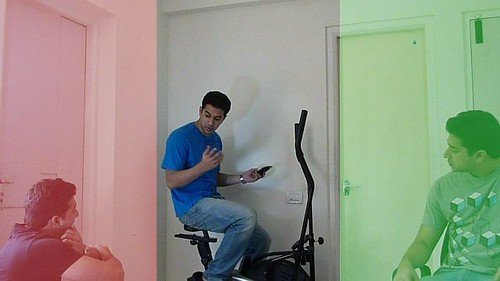
    Being completely new to special effects, we did what most software engineers do - Prototype! I did a test shot of being in two places in two different shots. Manu took these shots and blended them on Adobe Premiere using masking tools. The result looked much more “believable” than the Green screen effect. In fact, Green/Blue screens needed a lot more effort and correcting the interplay of light and shadow would have been a nightmare.

    Given the limited time, we decided to opt for masking for these trick shots. There was considerable effort in getting the lighting correct in these shots so that the videos would blend correctly without noticeable artifacts. One three-second shot needing the three Ranjans in one frame, took seven extremely long retakes across two days.

    The trick shot with 3 Ranjans and color highlighting the seperate shots

    A major time-saving step was testing these trick shots immediately on the laptop at location. By this approach, we could quickly check if the shots matched correctly. This helped us avoid disappointment and saved a lot of time potentially lost in post processing corrections.

    Most of effects were simplified due to careful planning before shooting. So by the time we shot the scenes with the overlay effects we knew that the camera angles had to leave some room for showing the dynamic menu selections.

    Movie Making 101

    Given the competition deadline, we had to finish a lot of things in the extremely short deadline. There are a lot of good resources on the web about short film making. But from our personal experience, here are some of the elements that went into “Avatars”:

    • Storyboarding 101: Avatars’ storyboard was pretty much about the camera angles and how the relative positions of the characters were maintained especially in conversation.

    • Camera-work 101: The widescreen frames helped a lot especially when 3 characters came together in the triangle seating for the trick shot. Some of the funny angles we tried were camera-in-the-bag and running-with-the-actor shots. Realised time and time again that hiding the camera from all the reflections is a big pain!

    • Screenplay 101: Shooting happened out of order and its very difficult to keep track of what’s not covered without a screenplay. Sometimes continuity-errors would crop up in editing (such as the bouquet in the final shot) and the scene would be reshot.

    • Acting 101: The more the number of actors, the more retakes is a good rule of thumb. Sometimes simple shots like opening eyes and waking up took an incredible amount of time to look “natural”.

    • Directing 101: A simple line like “OSCON went bust” can be said in a zillion different ways - comical, matter-of-fact or even condescendingly. A director needs to imbibe the spirit of the script and apply his imagination in these areas.

    • Lighting 101: Proper lighting will take 60% of your time. Avatars predominantly used bounce lights supplemented by free hanging fluorescent lamps and incandescent bulbs. Fluorescent lamps have a noticeable flicker.

    • BGM 101: The background music defines the mood and the tempo of a movie. The rock music in appropriate parts really helped.

    • Editing 101: Editing probably took way more time than I thought leading to all-nighters towards the end. It was entirely done in KDEnlive, a fantastic open source editor. Throughout the workflow, care was taken to keep in the intermediates in high quality HD.

    • Effects 101: There is an entire section on Effects above. Later, Manu got really good with the animated overlays and soon he couldn’t stop making them enough! :)

    • Titles 101: The titles were a 3D rendering of Google maps with cloned Google-pointers floating over a map of Mangalore. The entire modelling and compositing was done in Blender. Took 3 hours to render.

    • Compositing 101: We did minimal compositing for Avatars. Some color correction was added from Kdenlive to give the appearance of a film rather than a digital camera.

    • Marketing 101: The posters were done in GIMP overlaying the title renders on the film frames.

    What Worked What Didn’t

    Now that the movie is completed, it is probably a good time to do a post-mortem of what worked and what didn’t

    What Worked

    1. Having a full screenplay: Great communication tool and sometimes a management tool
    2. Having a team: Having your friends to collaborate makes the process more fun and focused at the same time. Late night mailers on gmail does keep you focused!
    3. Prototype: Checking the double-effect shot first
    4. Natural Lighting: We didn’t spend anything on lighting. We chose locations that were brightly lit. The living room and bedroom actually belong to different houses :)

    What Didn’t Work

    1. Sound recording: I have always found dubbing to be an issue in indie film making. We used a good mic and decent noise cancellation software, yet it was always unnatural sounding
    2. Learning Curve: When you have a deadline, its not always the best time to learning a new piece of software like KDEnlive. But Windows Movie Maker wouldn’t have cut it (pun intended).

    Conclusion

    All in all, it was a fantastic experience doing something creative with such a brilliant team. Avatars is a work that we are all proud of. Hope you enjoyed watching it as well!

    Frequently Asked Questions

    Q. Which camera did you use? A. We used a Panasonic Lumix DMC-Z3. This is an inexpensive point-and-shoot with HD video recording capabilities. We also used a tripod in some shots.

    Q. What software did you use? A. We used mostly open source tools like KDEnlive, Blender 2.56 and Audacity. It was completely edited on Ubuntu 10.10.

    Q. How long did you take to make the film? A. It took one day to make the screenplay, followed by 2.5 days of shooting and finally, 2 days for editing and dubbing.

    Q. Where all did you shoot? A. The entire movie is shot in Mangalore. The exterior shots were taken at Bondel Road and near Infosys. The interior shots were shot in Binary Homes and at my residence.

    Q. Is there a bloopers video showing all the mistakes? A. You bet there is. The bloopers and some behind the scenes stuff is here: http://www.vimeo.com/18817334

    Q. What was your budget? A. We filmed on nearly zero budget. We reused as much stuff as we could. The only things we bought for the movie were props like the bouquet and the coffee cups.

    Q. Where did you get the name ‘Oskon’? A. I had named the poor target of the Chinese mega-corp as OSKON without much thought. Later, I noticed that the toilet flushing system sensor at office had the letters ASKON engraved on it. So subliminal, huh?

    Comments →

    Strongest People Are The Ones With Passion

    “What is the most resilient parasite?”, the protagonist of ‘Inception’ teases us with this question. It is an Idea, he finally concludes. Once planted, he points out, it is almost impossible to completely eradicate a fully formed idea. The titular character of ‘V for Vendetta’ declared with a steady voice facing almost certain death “Beneath this mask there is an idea, Mr. Creedy, and ideas are bulletproof”.

    Yes. We are all driven by ideas. We are not talking about just about any idea. We are talking about ideas that tease us, inspires us, drives us and ultimately consume us. Yes, we are talking about passion here. There is no better word to describe the best in a human than the word ‘Passion’.

    Yet, Passion sounds animalistic and almost debasingly primitive to the casual observer. Perhaps, that’s why writers and even Hollywood scriptwriters choose the more higher abstraction of an idea. We may be influenced by various ideas, but the ones that instill passion are the truly dangerous ones.

    When I say dangerous, I mean in a positive, world-changing way that everyone of us should aspire. We often measure success by various yardsticks - Wealth, Fame or Power. Yet, time and time again, History has told us that the truly successful men and women are the ones who has left a lasting impression i.e. a legacy behind.

    Rat Race

    There is perhaps nothing to living an ordinary life, for it is mere existence. We spend a good part of our early life learning skills that enable us to earn a livelihood. Once we start earning, what do we do with that money? We acquire various goodies from new clothes to a new vehicle. We are happy until we compare ourselves with our peers and chase even bigger goodies - a car, an apartment and so on.

    We chase ephemeral happiness and in the process realise that we no longer feel the joys of this ’leveling up’ exercise. This is when you realise that the means had become an end to itself. The rat race that you got sucked into has inevitably turned you into nothing but a rat.

    This is a place that I sincerely hope that you don’t find yourself into. Once we realise that there is a finite time that we live and to make a legacy, one’s world view changes. You don’t get consumed by envy when you see your peers basking in their new shiny toys. You realise that that’s not your rat race. You choose the race you want to be in. That choice will define your passion.

    Be it trivial or profound, it doesn’t really matter. Your life is too precious to be wasted on a treadmill of Consumption. Go find what excites you. Excitement is infectious. If something genuinely excites you, there is no way that it can be contained. You might turn out to be an inspiration to others. Even if you change the life of one person, that is an enduring legacy.

    So, look around you. Look into the mirror. Do you see passion with a capital ‘P’? If not, it’s probably time that you’ve found the courage to seek those burning embers within you.

    Leaving you with these wonderful lines from Norah Jones’ latest “Young Blood”, a track I highly recommend:

    Watch is ticking like a heartbeat gone berserk
    Lost the chance to wind the key
    Roosters are nothing but clucking clockwork
    Our fears are only what we tell them to be
    Our fears are only what we tell them to be

    Comments →

    Delicious.com Shutdown: Perils of Cloud Apps

    First it was Geocities shutdown by Yahoo! without enough warning, now it’s Delicious.com and a bunch of others like Altavista, MyBlogLog, Yahoo! Bookmarks, Yahoo! Picks going the way of the Dodo.

    I have been a long time user of Delicious with more than 2000 bookmarks. It might be the only Yahoo service I use with the exception of Flickr. Its idea was simple yet powerful - Make your bookmarks public and find like-minded people.

    Lock and Chain [Image]

    This was a key service for people researching on a particular field or simply hobbyists who spend an unhealthy amount of time obsessing over board games or gardening. Perhaps, Yahoo has been unable to monetise it well. But it has not even tried, as evident from the neglect it has been getting ever since it was acquisition.

    As it might happen, Yahoo might open source the Delicious source code. I have heard that it’s written in Erlang. Perhaps this is the reason it has been difficult to modify or maintain. Nevertheless they could have open sourced the code earlier as Reddit has done and might have still monetized it.

    Personally, this raises grave concerns for cloud apps that I use. Recently Stallman warned that “Google’s ChromeOS means losing control of data”. What happens if one morning you hear than gmail, facebook, orkut or flickr will be shutdown? What happens to all your data? What about the implicit interconnections you had formed and the communities that you had been participating in?

    The clouds are getting ominously dark!

    UPDATE: Yahoo! has clarified that they are planning to sell Delicious and not shut it down. However, the concerns raised about cloud apps still holds good.

    Comments →

    « Newer Page 6 of 20 Older »