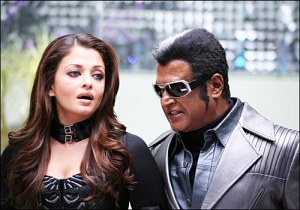
Saw Endhiran yesterday in a theatre full of people many of whom didn’t even understand Tamil (you know, when they laugh only at the jokes in English!) It was a wonderful experience, minus all the wolf whistles and dancing seen in a typical Rajini starrer film. Partially due to the fact that it is a relatively tame multiplex audience in Karnataka and partially because it was not a typical Rajini movie with cliched punchlines and mannerism. Instead, it was a good Indian sci-fi movie.
Even though the theme is as old as Mary Shelley’s Frankenstein, Endhiran shows the complexities that a sentient android robot, if ever built, brings in a form understandable even to the masses. It is a genuine attempt at bringing the moral issues of advancing AI technologies and how it can possibly impact our lives. The story or plot is rather an excuse to put together various engaging scenes and brings nothing entirely novel.
To say that Shankar has left enough interesting bits and pieces for the above-average audience would be an understatement. More on that later. I was expecting to a visual effects driven blockbuster movie and was instead surprised by the science fiction aspects of it. There is a lot of detail in the manner the robot manoeuvres i.e. magnetic attraction rather than dumb jet-packs.
The rest of the review has even more spoilers
The Geeky bits
As alluded previously, the movie is sprinkled with plenty of geeky stuff. The problems posed are really hard problems from the fields of machine learning and AI research rather than gimmicky questions. This shows the kind of homework that Shankar (or is it Sujatha?) has done for the movie.
Here is a sample of what the “Robot” can deftly handle and some other geek trivia:
Worms for infiltration of a network rather than a Virus (Take that Hollywood!)
Science Fiction References
Asimov’s Laws of Robotics - The scientist has a clever explanation why it doesn’t follow them. Otherwise this would have ruined the plot.(Thanks Rindo!)
I have some semi-informed notions of the Endhiran storyline and even the climax. Don’t worry, the boot-leg copies of the film are not yet out and these are just speculations. However, I have more than 2 decades of film-watching and popcorn-munching experience to back on. My guesses are:
Rajini’s dual roles will be as a scientist and the robot which he will build in his own image.
The robot become ‘self aware’ and will download and assimilate entire Indian history post independence in a scene with jazzy graphics and the camera rotating around the robot Rajini’s face. It will develop stronger moral absolutes compared to the scientist. It will understand through it’s AI brain that the root of India’s problem is… wait for it… Corruption
The scientist realises that his creation has created enemies out of his corporate sponsors who want it to be shut down. He turns ‘villian’.
Meanwhile, Aish the evergreen teeny-bopper develops a crush on the scientist Rajini. However, the scientist being a ’nerd’ doesn’t have any such feelings towards her.
One fine morning, Aish meets the Robot and mistakes him to be the scientist himself. The robot too develops a special ’emotional’ attachment towards her. Soon, sparks start flying (… literally).
The robot’s vigilante actions soon attracts national attention and he is feared and praised for his actions. This leads to climax where a major boss-battle with blinding computer graphics take place.
The real climax - Aish later finds out that she was also a robot, which explains her wooden expression throughout (the movie or her entire acting career? ;) ). The mechanical pair live happily ever after.
I can’t wait to see how right/wrong I am ;)
Disclaimer: This post was written purely for humorous purposes. This may or may not reflect the actual plot or storyline. No offence meant to anyone real or imaginary :)
** I have seen the movie now and here is the real review
You were merrily hopping through a lush green garden when you notice a giant grey pipe sticking out of the ground. Always ready for some action, you leap into the pipe without a second thought. You fall into a dimly lit underground passage. As you look up, you notice the sparkling gold coins hanging in the air. You realise there are probably hundreds of them. You can barely contain your excitement as you jump to pluck as many coins from the air.
Dreams in our childhood were sometimes made of episodes such as these. All thanks to extended bouts of playing Mario on our TV screens. The adorable plump plumber turns 25 this week. However, he is as fit as ever as one would notice from his acrobatics in his latest game ‘Super Mario Galaxy 2’. Mario and his sidekicks like Wario, Lugi and Pauline have appeared in over 200 titles over these years. This is a testament to Nintendo’s vision and innovation in creating the game industry’s first Superstar.
There have been various funny variations of one of the world’s most popular game title - Super Mario Bros (240 million in lifetime sales and still selling!). One game designer’s resignation letter was a Mario game titled ‘A Message for 2K Australia’ (his employer)! A geek proposed to girlfriend inside a Mario-like video game by spelling out the words “Lisa Will You Marry Me?” using gold coins. There are several other instances of Mario fans creating a 8-bit wedding invitation game to an entire room designed after Mario’s colourful world.
Evergreen Mario
There are no signs of Mario retiring atleast for the immediate future. Whatever be tomorrow’s technology be it 3D or full body motion sensors, you can expect Mario to be there and kicking some posteriors! :)
Disclaimer: Mario and all related characters and elements are copyrighted to Nintendo
Early adopter: An early adopter is a person who embraces new technology before most other people do. Early adopters tend to buy or try out new hardware items and programs, and new versions of existing programs, sooner than most of their peers. According to a theory called Diffusion of Innovations (DoI) formulated by Everett Rogers, early adopters make up 13.5 percent of the population – Johns Hopkins Inst.
I am not an early adopter when it comes to gadgets. But ever since Kindle was introduced, it was pretty clear to me that I am going to buy an Ebook reader. For me, moving around books has been always a problem. Moreover, I am allergetic to old print.
Three months back, close to my birthday, I ordered an Infibeam Pi ebook reader. At that point of time, for ten thousand rupees, it was considerably cheaper than Kindle in India. Also, I did not like the idea of Amazon playing “Big Brother” where your book collection was stored in the “cloud” and subject to the mercy of their deletion policies. Pi didn’t have features that I didn’t need and it had some which I felt were missing in Kindle. More on this later.
Three months later, I would make the bold assertion that Ebook readers are the future. For a voracious reader, it is a must-have and with falling prices, it will replace paper books almost completely. I would expect students to be the most evident benefactors making it unnecessary to carry heavy textbooks and allowing even remote locations to have a wider collection of books than ever before.
In case you are interested in a detailed review of Pi reader, read on…
First Impressions
The package arrived in two weeks with several friendly calls reminding me that the package is “on its way”. When it arrived, I was happy to find that Infibeam has invested quite some time and effort to make the packaging attractive and safe for transit.
What surprised me upon opening was that the Pi logo on the screen. At first I assumed that it’s a decal or a sticker. But it seems the screen is always ‘on’ in a standby state! This shows how little power it consumes while displaying a static image/text. The only power consumption that happens is when the display changes. The display change takes around half a second of flicker. But this is not as annoying as it sounds and one quickly gets used to it, like turning the pages of a book.
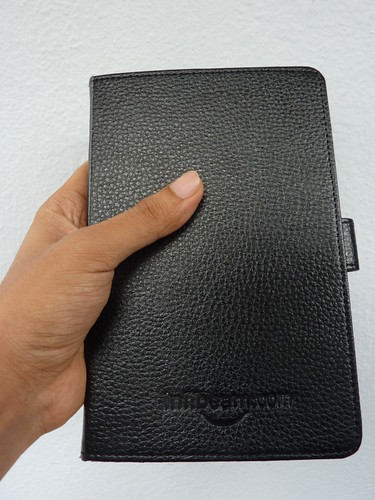
In terms of appearance, the closest I can say is that Pi is like holding a piece of unwrapped white Milky Bar. Except that it is one giant booksized flat smooth chunk. It is thinner than most phones and being light quite easy to hold. There is a silver four way directional pad at the bottom right, which is similar those found in most phones. Most of the other keys are on the left leaving the bottom part mostly vacant and underutilized.
Interface
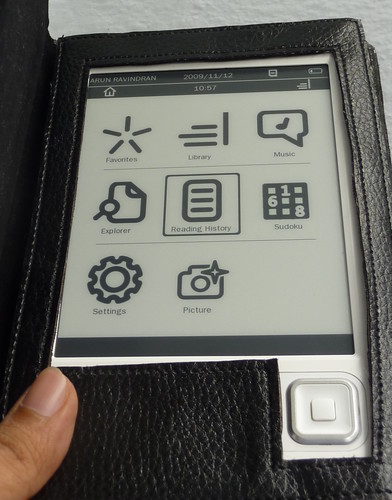
The user interface is excellent with big bold icons. You don’t need a manual to understand most of its functions. Again, this was real surprise for me for an Indian product.
In terms of features, it has a music player and a sudoku game built in. Playing music can reduce the battery life considerably. It supports the EPUB format which is an open ebook format popularly used for the iPad. It also recognises Kindle’s (.mobi) book format, PDF, RTF, HTML and even most images. The latter makes it really a great option for reading comics (with smaller page sizes) even thought it will appear in greyscale.
The most common question I hear is - How good is it for PDFs? The answer is - it depends. If the PDF is mostly text, then it can reflow the text and handle the zooming of text pretty well. If the PDF is mostly images or scanned text (without OCR), then it would not look that great when you zoom. This is a deal breaker if you are going to read a lot of technical books for e.g. programming books or mathematical works. It is perfectly fine for general reading and comics.
Use cases
I have found myself reading a lot more due to the Pi reader. In fact there are many situations where Pi’s long battery life and portability came handy. Here are some such scenarios I could think of:
Extended Power cuts: The reader can last you days not just hours on a single charge
Documentation: Learning a lot of project docs
Students: As mentioned earlier this an excellent device for a student with lots of ebooks.
Clean Desks: You can keep reading multiple papers without the mess on your desk
Travel Companion: A lightweight companion in your laptop bag carrying thousands of must-reads
Comic Geek: Reading comic series compilations at a stretch
Ebook formats
There has been quite a bit of discussion around ebook formats like ePub or Kindle’s mobi. If you are a normal user who would directly download books from Infibeam/Amazon, read them and forget about it, then you can skip this section. On the other hand if you are a geek, who prefers ogg over mp3 or vice versa, then you might have many questions. Like which is ebook format is the most open, whether these formats are easily interconvertable etc.
EPUB is the likely future standard than mobi. Kindles cannot open EPUBs, which has resulted in many holding back their buy decision. EPUB is the most open format; it’s basically a zip file with xhtml and images. Just unzip and read with a browser! Even Google has recently offered over a million free e-books in EPUB format.
EPUB supports features like table of contents which is very useful for longer texts. EPUB allows for “richer” formatting. You can, for example, have things like “drop caps”, pictures with text that “flows” around them, or embedded fonts, none of which Mobi supports.
Personally, I have converted most of my ebooks into EPUBs. Using a tool called Calibre it is quite easy to convert from and to ebook formats.
PROs and CONs
Of course, the Pi reader could be better, a lot better. Here is a quick list of things that I feel are its pros and cons:
Pros
EPUBs: Supports EPUB quite well. In fact, the reading experience of EPUBs is the best compared to all other formats on Pi (even better than .TXT!).
Pages Numbering: Page numbers are maintained as in a real book. Good for teaching
Screen: The screen is the same Eink technology as the Kindle. For people who are lusting after iPads need to see this screen- you cannot make out the pixels. It is really gorgeous!
SD Card Support: Infibeam has both internal memory as well as swappable SD card support. SD cards are cheap and keep getting cheaper. You’d never run out of space.
Indian Languages: Lots of Indian language books at Infibeam bookstore
Battery life: Once charged, thanks to my occasional use of 1-2 hrs per day, it lasted two months! The lack of WiFi probably helps in this case.
Cons
Need for PC: It’s not a standalone device. You need your PC to add books or a friendly neighbourhood geek.
Illumination: Recommended to use under plenty of light. Opposed to iPad’s or Laptop’s glossy surface which works best in the dark. This one is best read near a window or under a tubelight, just like a book.
Button Placement: Back button made more accessible, say upper right would have avoided a lot of fumbling around. It’s awkwardly placed at the side.
Headphones Incompatible 3 mm earphone jack is not compatible with your favourite headphones
No Dictionary
No net browsing With a screen that takes half a second to refresh I am not sure if its the best device for browsing. Kindle comes with an experimental browser. But with spotty wifi in India, I’m not sure how much you would miss this feature.
Contrast: The contrast could be slightly better. The grey background reminds you of a filter-paper-like texture of a paperback, but the gorgeous typefaces conveys its classy pedigree.
Auto rotate - No auto-rotate based on gyroscope like iPad. Won’t this be annoying? I’m not sure.
Lack of Color or Touch Display - This is a limitation of all ebook readers. I miss color only while reading comics. Touch screen is a nice to have.
No full keyboard - A full keyboard is useful if you want to make notes, annotations or searches. Personally, I won’t find much use for it.
Oversmart .txt Handling: If you open text files esp from Gutenberg.org, the reader tries to identify headings and quotations. This sometimes goes wayward resulting in multiple sized fonts. There should be an option to disable this “intelligence”.
Cheap Cover: The Infibeam comes with a faux leather cover that is sturdy but uses a cheaper felt on the inside. The reader often slides out while reading within the cover. But it can be easily secured with a double sided tape :)
Summary
Ebook readers are great devices. Infibeam Pi is an excellent device for its stated features. If the prices came down like the Kindle, there would be a lot more adoption in India.
Gallery
Here are some photos of Pi reader (visit the Flickr page for higher resolution shots with captions):
These days whenever the topic of corruption or malpractices within our political system is discussed, some strange retorts have come into vogue even after half a century of gaining independence. It is not the anger of blind patriotism or even resigned feeling of helplessness. It is pithy remark, ‘Why don’t you change the system, then?". This comment is perhaps based on the dwindling voting turnout by the upper middle class and declining participation of the youth in politics.
This is a very broad generalisation perpetuated by popular literature and Bollywood films. The so-called educated and socially responsible citizens do exist in our country. But they form a minority of our population and do not win any elections in our “democratic” system.
In a democracy, numbers matter. A well-educated English speaking youth wearing western formals will not appeal to the uneducated masses. The political appeal of a khadar wearing vernacular speaking shrewd and manipulative politician will continue to exist until the majority the Indian population enjoys education and cannot identify with such people anymore. The vast majority of the politicians are merely selling pipe-dreams to the naive population while exploiting their regional differences claiming better representation. The legitimacy of such claims are rarely questioned or debated by majority of the masses.
Till that transformation in the society as a whole will happen, we cannot blame the middle class for not taking steps to become more involved in the political process. In fact, there have been severalindependent parties by students from prestigious colleges like IITs who have never won elections. Everyday, the average middle class person protests against corruption and nepotism which falls into deaf ears and eventually have to succumb to it grudgingly.
I strongly believe messages like “Don’t Talk, But Act” are over-simplistic and even harmful. The people who voice their opinions are genuinely interested in improving the system and expose issues present in the society. Their voices are needed to stimulate change and must not be suppressed. Awareness for greater involvement in the political process is necessary and often justified. But their means of expression must not be ridiculed and taken as weaker substitutes to action. Political will is often influenced by greater citizen awareness rather than by direct vigilante action.
Here the so-called perpetrators are also the most severe critics of the political system but feel helpless. They are victims of a system which purely believes in the opinion of the bigger numbers. Unless the illiterate and underprivileged who form majority of our population have better living conditions and education, the system will continue to elect perpetrators of such a decadent political system. This vicious cycle can be broken not by standing in elections and asking to vote for yourself, but by helping in creating a social change. The real change lies in improving the living conditions of an average Indian. Our real and possibly only hope lies there.
How many times have someone forgotten an important line in your email despite it being bold, highlighted and underlined? How many times have you come across a mail that the sender himself has not read even once? How many programmers you have seen in online forums who ask the same basic questions that were earlier answered again and again?
The geeks have a word for this apparently inability of the end-users to read a manual - RTFM or Read the Fine Manual. The impatience of getting to use a brand new gadget quickly wears off once you cannot get it to work despite several attempts. The immediate reaction seems to be to reach out for the phone than to read the manual. You begin to raise queries to Tech support when the instructions have been clearly given in the manual. This is where the problem starts. The waste of your time and the Tech support’s time is exactly what the user manual tries to avoid. We will try to explore why this happens.
Why don’t we just read?
It is not the technology users or programmers who are guilty of committing the “Ask before you check” crime. This a common malaise and can be seen everyday while mailing or sending documents for review. It seems there is hardly anyone who does a thorough job of “Reading” these days. In fact, if you know someone who actually reads every line that’s send to him/her, I am sure that person is a quite valuable asset to your team for that particular “skill”.
The vast majority of us are either skimmers or ADHDs (Attention Deficit Hyperactivity Disorder). The former prefer to gloss over the details and absorb the high level details from 30,000 feet. Once their 5 minute power-read of a document is complete, they bask in the satisfaction of having completed an arduous task of understanding the document in a fraction of the normal time. These superhuman feats are often fraught with the hazard of missing significant detail, but often skimmers are influential enough to disregards such minor details completely. The ADHDs are the ones with coffee coursing through their veins. They often try to start reading and few seconds later, completely give up hope. They procrastinate endlessly about the pile of documents waiting for them at their table. They might eventually turn to skimming but even then it turns boring pretty quickly.
These specimens of our species have been evolved by the forces of nature at work in the last few decades. Call it “Information Overload” or the “Twitter Effect”, there are simply too many streams of information competing for our attention at any given time. The email pop-up on your mail program, the tweet from a celebrity, an SMS from your friend and your phone rings at the same time on a particularly crazy moment. This multitasking is immensely taxing for your brain and in a desperate attempt to cope up, your brain tries to focus on the high-level details rather than the smaller details. The smaller details sometimes get overlapped with each other or completely forgotten and lead to embarrassing situations. Nonetheless we seem to be trapped in this multiple-thread hell as a necessary evil of modern life.
Can we ever truly multitask?
We often think that we are good or bad at multitasking depending on our assessment of ourselves. But the question remains as to if we are even capable of multitasking? This might sound like a silly question at first. Surely we can eat while talking over the phone. Or even listen to a radio show while driving. But have you ever taxed your brain for activities that involve thinking simultaneously? Have you tried writing something while talking over the phone? By writing, I don’t mean a routine chore like signing a cheque. I mean writing a prose or a report which is independent from the telephonic conversation. It might be extremely hard or even impossible to focus on both at the same time.
This leads to an interesting school of thought that our brain works best when there is a single thread of thought. To explain it in analogous terms to computer geeks, our brain is a single processor 1. The only way we can multitask is by time sharing. We convert each activity into tiny slices which require our attention and quickly juggle through each slice like a skilled juggler. But at any given point of time there is only one slice on your mind, one ball in your hand. The rest are, so to speak, in the air and waiting for their turn.
Many Indian and oriental meditation techniques try to train your mind to develop focus on one particular activity at hand. There might be several other activities but treat them temporarily as distractions and try to train your mind to take the current activity to a logical end-point. The distrations can be blocked mentally, however it is best to actually prevent such distractions in the first place.
Next time you try to read a long document, turn off all the potential distractions. Most mail programs can be disabled to supress pop-ups. You can also turn off your twitter client and put your phone on silent/vibrate. Resisting the temptation to switch to a new activity is the key. Even at an early stage, the rewards of such focussed sessions are easy for one to see. The clarity it brings to your communications is also quite noticeable.
TL;DR
There is prevalent practice in most online forums to write a short summary of a long passage or comment for impatient readers called TL;DR i.e. Too Long; Didn’t Read. I might say that the TL;DR for this writeup is that one’s reading comprehension can be vastly improved if you can focus solely on the task of reading. But that would defeat the purpose, as you would miss the exploration of the problem, classification of the worst offenders or even the analogy of a juggler to the brain elaborated in this writeup.
But then, if you have reached this far, you are not the one who should be reading this!
Technically our brain is a huge parallel computer. However when we conciously try to manage two parallel tasks, our brain switches from one task to another ↩︎
This might turn out to be a pedestrian writeup but enough of pile-ups. Enough of puns, actually. They say you really appreciate an interview process only if you have sat on both sides. Same goes for driving. Unless you become a driver you’ll never know what these fancy coloured tin boxes zipping past you are really thinking.
These little nuggets of wisdom are the ones I always wanted to share to my clueless pedestrians. Sometimes, I have wanted to pull down the glass and scream till its drilled down into their thick skulls. But generally speaking, ignorance is bliss. They look so happy without this knowledge. That’s definitely not normal.
So without further ado here are the top things that every person who comes within 100 meters close to a road must know:
Hang-up - I know you love the ones you…ummmm love. But if you are walking close to the road, please do, in the name of Graham Bell, turn off the damn mobile. Unless you want your beloved to hear a live audio of a road accident, it is best to keep a close watch on the road first. I know, I know, you can multitask. But trust me, from a driver’s seat, I have honked at so many mobile-zombies till my hands ache.
Don’t be shy to look at the right direction while crossing - Since you are in India, you know that vehicles come from your right. Yet, so many of us choose to carefully watch your left before leaping to the middle of the road. There might be an oil tanker blaring its horns from your right, an auto squawking endlessly in an annoying tirade and even a friendly pan-walla kaka mouthing obscenities, yet you would be transfixed to your left. I mean, what form of dark physical humour is that? Unless, you have recently completed a very long onsite trip from US or the Middle East, you ought to know that the things with wheels come from your right. No, not that right. The other right.
Don’t cross in an underlit road - It is a long day and you are walking back home with that blessed device on your ear. Streetlights are alternately working and in some places pitch dark. Guess what, in your infinite wisdom, you pick the dark spot to cross the road. The next thing you know, a speeding Honda City missed you completely. Yes, they come with headlights these days. But being seen on the road and not seen, is the difference between life and death.
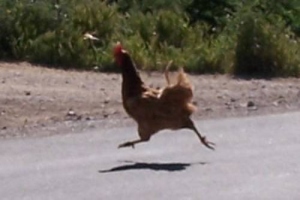
Don’t dance in front of cars - I know that you know some moves, but tarred roads are not the best dance floors. I am referring to those half-minded pedestrians who cross the road, see an approaching vehicle, pause, then moonwalk, then pause, then move forward, then do an about-turn. Imagine the horror of the guy in that incoming vehicle. He is in a hurry and all he can see is chicken dance. So the advice is - JUST CROSS SLOWLY, the drivers will take care of manoeuvring the vehicles. Don’t be a moving target.
Don’t hold hands - Don’t get me wrong, I have nothing against PDAs (not the electronic kind, the kind that couples do). There is a split second difference between a person in the line of an incoming vehicle and outside it. So don’t drag someone along while you cross. Unless the person is a clueless toddler, let that person decide whether to cross or not.
Don’t pretend to be a traffic cop - There are so many not-so-old fellows who have been given the honorary tile of traffic cops… IN THEIR DREAMS. They tend to authoritatively stretch their palms to signal a stop for an incoming vehicle. They also get to decide if they have goofed up and cannot cross, to signal that we should continue driving along. Thanks, but no thanks. You are of no help, but I appreciate the straight face in times of absurdity.
These are the ones I could think of straight off my head. But I am sure there are more. The clueless pedestrian will never cease to amuse me.
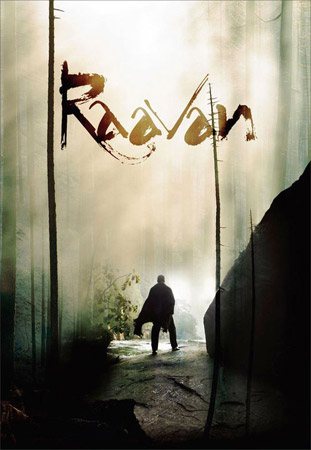
‘Raavan’ is not the Mani Ratnam movies of the eighties/nineties where human relationships are painted on the broader context of a social problem (Terrorism in Roja, Underworld in Nayakan). It firmly belongs to the ever-shrinking world of the 21st century and the complexity of interpersonal relationships come to the fore. However, it isn’t a run-of-the-mill revenge drama by the genius either.
It has to be rather seen as a modern interpretation of the timeless epic of Ramayana. On the screen the characters unfold and the motives that drive them help you relate to their counterparts in the classic, leaving a uniquely rewarding experience. Mani has admirably adhered to the characters and have not compromised any of their attributes for the sake of novelty. Yet he brilliantly manages to give a fresh perspective in the climax.
Unlike his earlier films, visuals do not just serve as a aesthetic backdrop. In Raavan, it is visuals that tell the story and essentially the defining character of the movie. The unique camera angles from the sideways shots of a dragon fly to the wings of an eagle in flight conveys a jungle filled with eyes. Yet, Beera the forest brigand is an elusive being momentarily seen and the next moment unseen. A maligned force hiding gloriously in plain sight. An enigmatic presence in the teeming abundance of nature. You realise at once that you are truly in Raavan’s “Golden Lanka”.
Camera falls in love with Ragini, played by Aishwarya Rai, from the moment we find her in a raft. It slowly dives into her emerald green eyes and thus hopelessly smitten. It lazily flirts with her, falls into her tresses and even while it momentarily glances afar, only to longingly pan back to her.
Stuck almost claustrophically in a teeming forest, Ravan heightens your senses to a state of alertness. This sensation is almost killed off thanks to the slow progression of events in the first half. But the visual feast continues till the very end and leaves a lasting impression thanks to the mavericks behind the camera.
You can bet on ARR to effortlessly weave the music and background score into the story. The dominant tribal and folksy elements in the score amplifies the experience. Gulzar’s pen again works its magic and sometimes the story relies too much on that magic. For instance, the motives of the bandits are not fully clear and only revealed through the song ‘Thok De Khilli’. This is rather unfortunate because of the odd placement of the song in the heat of the events.
Thankfully, the story picks up in the second half leading to some unexpected twists. Certain scenes are truly hair-raising (such as Beera confronting Sanjeevani) and Mani rewards you for your patience.
I feel Mani has essentially conveyed the essence of Ramayana which is a study of two legendary heroes Ram and Raavan. In fact, Ram and Raavan are essentially the same heroic personality in two different moral planes by mere turn of events. The motives of Raavan were questionable, yet his conduct was indeed noble. In a different context, the roles may have been reversed and yet one might praise the virtuous characters of one versus the other. It is precisely this irony of the epic that the master story-teller Mani Ratnam has tried to portray.
Addendum: Raavanan Review
One of the major flaws of Raavan (Hindi) was the casting. Abhishek Bachan’s overacting and Vikram’s unconvincing portrayal as the ‘good guy’ left audience confused as these characters had shades of grey.
On the other hand, the casting in Raavanan (Tamil) is perfect to a tee. Vikram’s subtle yet engaging performance, keeps you guessing if this brute is even capable of love. The fire and insanity glowing through his eyes justifying the eccentricities of the character. Prithiviraj perfectly suits the role of the duty bound police officer. Karthik also fits in his whimsical yet likeable character perfectly.
The dialogues are also better in the Tamil version. Cheesy dialogues like ‘Is Beera a Robin hood or a Raavan?’ have been thankfully omitted. Some scenes by Vikram manage to convey the visual narrative better. For e.g. when Veera enters Dev’s tent (which he refers to as his palace), his shock-then-anger reaction to his mirror image is quite interesting. It effectively conveys that the Veera/Dev characters are mirror images of each other.
In a nutshell, Raavan was boring till the end of the first half while Raavanan manage to engage till the very end. It is amazing to find such contrast in the movie experience despite identical screenplay and visualisations. So my recommendation is clear - it’s Raavanan all the way.
We lead life like Batteries. We give out our best everyday. We push our limits harder and harder. We absorb. We respond. We re-absorb. We win. We perish. We dance in the motions of a rhythm we call Life. Yet somewhere that very thing is forgotten - Life.
We lead such pumped up lives that eventually we are maxed out. We badly need a recharge. We badly need that long overdue vacation. I had mine last weekend. It was an getaway to Munnar in Kerala. Though it was not my first trip, it was more special with my family. Climbing those long winding roads along the misty slopes covered with tea plantations, you find a place where you can finally recharge. And thank god for that! :)
Munnar, if you haven’t been there before, is a very different experience from, say Ooty. It has not yet been a victim of heavy tourist commercialisation where every pore of its surface has been clogged with teeming mercenaries. It still retains some of its pristine virginal green meadows and tall imposing eucalyptus trees. Even in this off-season, its lush green freshness practically invites you to spend many idyllic evenings sipping hot garden fresh tea.
Kavya was literally on her toes all the time. With her newly gained ability to balance on her own, she has successfully crossed from a limited 2D experience to a full fledged 3D experience, as its fashionable to say these days. Her shriek expressing sheer happiness sometimes crosses into the ultrasonic barrier and is quite effective in confusing bats. Her greatest weapon is of course her oh-I’m-so-sorry smile, to which even the most stone cold hearts turn into putty in mere seconds.
We all returned with memorable moments and saturated cameras (which seem to have more memory than us these days).
Hi folks, this is your friendly Granpa… It’s a chilly night out there and we’ve a nice warm fireplace inside. So grab your cup of hot chocolate, wrap yourself in a warm blanket and sit next to my armchair.
Back in my good ‘ol days there were lots of people who called themselves Writers. When I say Writers, you might think of bespectacled young chaps hunched over a word-processor, punching out words on their Macbook draped in hand-knitted scarfs and wearing comfy flip-flops. But no, I am talking about good ol’ pen and paper blokes who toiled all day beside a mountain of crumbled paper overflowing from their wastebins. When life was hard and every word was measured and well thought out. Their prose was water-tight and flowed from line to line like a swift arrow of unbroken thought.
There were two kinds of writers, though - Fiction and Non-fiction. The former were always popular. People loved to get trapped in their colorful web of imagination. They would get lost in far-away worlds of fire-breathing dragons or colourful unicorns. But the non-fiction writers had it tough. Every word of their’s was picked on and taken apart. “What is your reference for this?”, the critics would clamour. “Prove your claims”, the technical ones would demand.
Despite all this, the technical writers, the journalists or the biographers wrote volumes and produced great works. In fact, the critical audience made them write impeccable and widely researched bodies of work.
Time rolled by and the Internet happened. Now, don’t get me wrong, Internet wasn’t a bad thing at all. But, soon everyone realised that they could be and later, would be - a Writer. Nobody bothered to label themselves as Fiction or non-Fiction. Both genres would be intermixed in the same, so-called, blog-post in the interest of a greater subscriber base. After all who wants a recital of dry facts. Sprinkle some controversy and hyperboles, mix them well and let’s make merry - was the mantra.
Soon, technical writing was not worth the… err… bandwidth (?) they used up. Hearsay became random tit-bits which became fun-facts and later authoritative references. Nobody, checked the authenticity of what was written or passed around. Eventually, nobody regarded the technical writers as well as they did. Some poor ol’ timers like me found it difficult to survive by technical writing alone. So, we switched to better jobs.
“So what did you switch too, Granpa?”, asked the little attentive one with a glint in her eyes.
The Grandpa gave a long sigh and answered with a sour look, “Well, I write jokes for Reader’s Digest”